
 English
 Español
 Pусский
 العربية


stiffness tester
A stiffness tester is a laboratory instrument used to measure the resistance of a material to bending, flexing, or deformation. It is widely used in quality control, research, and product development to evaluate the mechanical properties of paper, cardboard, plastic films, fabrics, laminates, and other flexible materials. By determining how much force is required to bend a sample by a specific angle or to a specified deflection, the tester provides valuable data for assessing material performance in real-world applications.The basic principle of a stiffness tester is straightforward. A sample is placed in the testing position and subjected to a controlled force or displacement. The instrument then measures the response of the material, usually expressed as bending stiffness, flexural rigidity, or resistance to deflection. Different testing methods may be used depending on the type of material and the relevant international or industry standards. Some testers apply a cantilever method, while others use a three-point bending approach or a fixed-angle bending system. The selected method influences the results and should match the intended application.Stiffness is an important property because it affects how a material behaves during processing, transport, storage, and end use. For example, paper and cardboard with appropriate stiffness can feed more smoothly through packaging equipment and maintain better stacking strength. In the textile industry, stiffness influences drape, hand feel, and garment performance. For plastic films and laminated materials, stiffness can determine whether a product is suitable for packaging, labeling, or structural support. Accurate stiffness measurement helps manufacturers maintain consistency and ensure that products meet design requirements.Modern stiffness testers are often designed with digital controls and automated data processing. These features improve accuracy, reduce operator error, and make testing more efficient. Many instruments include a touchscreen interface, adjustable test settings, and software for storing and analyzing results. Some models can perform multiple tests quickly, making them suitable for both laboratory and production environments. Repeatability and precision are key advantages, especially when testing large batches of materials.Sample preparation is also an important part of the testing process. The specimen must usually be cut to a standard size and conditioned under controlled temperature and humidity before testing. This ensures that environmental factors do not distort the results. Since stiffness can change with moisture content, temperature, thickness, and material orientation, standardized preparation and testing conditions are essential for reliable comparisons.In summary, a stiffness tester is a valuable tool for evaluating the bending resistance of materials. It supports quality assurance, product development, and material comparison across many industries. With accurate testing and standardized methods, users can better understand material behavior and make informed decisions about manufacturing and application suitability.
Produit
Catégorie:
-
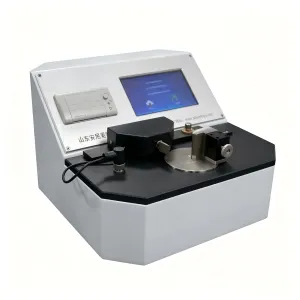
Testeur de rigidité numérique
Leur classification: Paper Testing InstrumentsVues: 474Numéro:Temps de libération: 2026-06-04 16:51:00Le testeur de rigidité numérique est un instrument spécialisé pour mesurer la résistance à la flexion (rigidité) du papier et du carton, conçu selon la méthode de flexion statique acceptée au niveau international. L'angle du test de rigidité est de 15° (réglable de 1 à 90°), avec une plage de mesure de 0 à 500 gf, une résolution d'affichage de 0,001 et une précision de 0,1 % FS. Il dispose d'un écran tactile couleur avec plusieurs options d'affichage d'unités, notamment gramme, mN, LB et OZ, et d'un temps de test réglable de 1 à 90 s. Il convient à la mesure de la rigidité à la flexion et de la rigidité au pli du papier et du carton. -
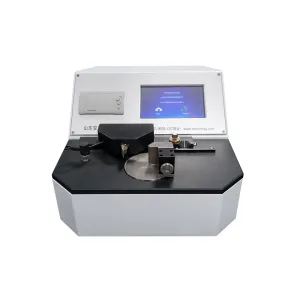
Testeur numérique de rigidité à la flexion
Leur classification: Paper Testing InstrumentsVues: 358Numéro:Temps de libération: 2026-07-10 08:50:01Le testeur numérique de rigidité à la flexion est un instrument professionnel permettant de mesurer la rigidité à la flexion du papier et du carton. Il convient à la détermination statique de la rigidité à la flexion de divers papiers, cartons et matériaux d'emballage. En tant que pionnier dans l'adoption d'une interface homme-machine à affichage de courbe LCD, ce testeur multifonctionnel permet de régler librement l'angle de courbure entre 1° et 90°, couvrant les tests standard de 7,5° et 15° ainsi que le test de rigidité au pli à 90°. La longueur de pliage est sélectionnable de 5 à 50 mm par pas fixes (version manuelle) ou réglable en continu de 5 à 60 mm (version automatique), et le temps de test peut être réglé de 3 à 35 secondes. L'instrument dispose d'une mise à zéro automatique, d'un affichage de la courbe force-temps-angle en temps réel, de statistiques de mesure automatiques et d'une impression. Après test, il revient à la position initiale à grande vitesse avec une vitesse de retour réglable de 0,55 à 20°/s. Tous les paramètres de performance sont conformes aux normes GB/T 23144 et GB 22364-2018, ce qui en fait un instrument de configuration standard pour les tests de rigidité à la flexion dans les usines de papier, les industries de l'emballage, les instituts de recherche et les agences d'inspection qualité.
Actualités
Catégorie:
Aucun résultat de recherche!
Affaire
Catégorie:
Aucun résultat de recherche!
Vidéo
Catégorie:
Aucun résultat de recherche!
Téléchargement
Catégorie:
Aucun résultat de recherche!
Recrutement
Catégorie:
Aucun résultat de recherche!
Produits recommandés
-
NEWS
Testeur de rigidité numérique
En savoir plus



 Téléphone