
 English
 Español
 Pусский
 العربية


puncture tester
A puncture tester is a specialized testing device used to evaluate the resistance of a material, product, or package against penetration by a pointed object. It is widely applied in industries such as packaging, textiles, rubber, plastics, medical products, and protective materials. The main purpose of a puncture tester is to measure how much force or energy is required to puncture a sample, helping manufacturers assess durability, safety, and overall performance.The basic working principle of a puncture tester is straightforward. A sample is securely fixed in a clamping system, and a probe, needle, or pointed striker is driven toward the sample at a controlled speed. As the probe presses against the material, the machine records the force, displacement, or energy needed to cause puncture. These measurements provide valuable data about the material’s strength and structural integrity. Depending on the design, the tester may operate mechanically, electronically, or through a combination of both.Puncture testers are often equipped with high-precision load cells and motion control systems to ensure accurate and repeatable results. Many models include digital displays, computer software, and data storage functions, allowing operators to monitor test curves in real time and analyze results afterward. The test parameters can usually be adjusted according to different standards or product requirements, such as probe shape, test speed, clamping force, and sample size. This flexibility makes the equipment suitable for a wide range of testing applications.In packaging applications, a puncture tester is commonly used to evaluate cartons, corrugated board, films, and flexible packaging materials. It helps determine whether a package can withstand rough handling, pressure, or accidental contact during transportation and storage. For textiles and protective fabrics, puncture testing is used to assess tear resistance and protective performance. In the medical and industrial fields, it can be used to test gloves, membranes, and safety barriers where puncture resistance is critical.One of the key advantages of using a puncture tester is its ability to provide objective and standardized results. Instead of relying on visual inspection or subjective judgment, manufacturers can obtain quantitative data that supports quality control, product development, and material comparison. This is especially important when designing products that must meet safety regulations or industry standards. Regular puncture testing also helps identify weaknesses in material formulation, thickness, structure, or manufacturing process.Modern puncture testers are designed for ease of operation, high accuracy, and long-term reliability. They often feature protective enclosures, automatic return functions, and user-friendly interfaces to improve safety and efficiency. Some advanced systems can perform multiple test types and generate detailed reports for laboratory or production use.Overall, a puncture tester is an essential instrument for evaluating material resistance to penetration. By delivering precise and repeatable test results, it supports better product design, improved quality control, and greater confidence in material performance across many industries.
Produit
Catégorie:
-
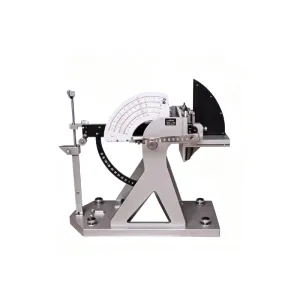
Testeur de crevaison
Leur classification: Paper Testing InstrumentsVues: 267Numéro:Temps de libération: 2026-07-13 09:56:26Le Testeur de perforation est un instrument standard spécialement conçu pour mesurer la résistance à la perforation du carton ondulé. Il est largement utilisé dans l'inspection de la qualité dans les usines de fabrication de cartons et de boîtes, dans la recherche sur les matériaux dans les institutions scientifiques et dans l'évaluation des performances dans les agences d'inspection des produits. L'instrument est conçu et fabriqué conformément aux normes ISO 3036 (Détermination de la résistance à la perforation du carton) et GB/T 2679.7 (Détermination de la résistance à la perforation du carton). Il dispose d'une plage de mesure de 0 à 48 J, équipée de quatre échelles : A (0 à 6 J), B (0 à 12 J), C (0 à 24 J) et D (0 à 48 J) avec la plus petite graduation de 0,05 J, répondant aux besoins de test du carton fin au carton ondulé robuste. L'instrument comprend un mécanisme de serrage rapide, une poignée de commande avec fonction de retour automatique et des fonctions de protection de sécurité complètes pour un fonctionnement sûr et fiable. Avec des dimensions hors tout de 900 × 800 × 410 mm et un poids d'environ 100 kg, il s'agit d'un appareil de test robuste, durable et indispensable pour l'évaluation de la résistance à la perforation et le contrôle qualité dans l'industrie des cartons et des boîtes.
Actualités
Catégorie:
Aucun résultat de recherche!
Affaire
Catégorie:
Aucun résultat de recherche!
Vidéo
Catégorie:
Aucun résultat de recherche!
Téléchargement
Catégorie:
Aucun résultat de recherche!
Recrutement
Catégorie:
Aucun résultat de recherche!
Produits recommandés
Aucun résultat de recherche!



 Téléphone