
 English
 Español
 Pусский
 العربية


mask filtration efficiency tester
A mask filtration efficiency tester is an essential device used to evaluate the ability of protective masks to filter airborne particles. It is widely applied in laboratories, quality control departments, manufacturing facilities, and certification testing environments. The main purpose of this instrument is to measure how effectively a mask blocks particles of different sizes while allowing breathable airflow, helping determine whether the mask meets required safety standards.The tester typically works by generating a controlled stream of particles and passing it through a mask sample under specified conditions. Sensors then measure the concentration of particles before and after the mask. By comparing these values, the system calculates the filtration efficiency. In many cases, the tester also measures breathing resistance or differential pressure, because a mask must balance protection and comfort. High filtration efficiency with excessive airflow resistance may reduce usability, so both performance indicators are important.Modern mask filtration efficiency testers are designed with high precision and automation. They often include an aerosol generation system, particle counting sensors, airflow control units, sample holders, and a digital display or software interface for real-time data analysis. Some models support multiple testing methods, such as sodium chloride aerosol testing, paraffin oil aerosol testing, and other standardized particle challenge tests. These methods help simulate different environmental conditions and evaluate mask performance for various applications.One of the major advantages of this tester is its ability to provide consistent, repeatable, and objective results. Manual inspection cannot accurately determine filtration performance, but an automated testing system reduces human error and improves reliability. This makes it especially useful for product development, routine quality checks, and compliance verification. Manufacturers can use the results to improve material selection, structural design, and production processes.The tester is commonly used for disposable medical masks, respirators, industrial protective masks, and other respiratory protection products. It can also be applied in research and development to compare different filter materials, layering structures, and production technologies. With increasing attention to respiratory protection, the demand for accurate filtration testing has grown significantly.In addition, a mask filtration efficiency tester contributes to public safety by ensuring that masks on the market perform as expected. Accurate testing helps protect users in healthcare, industrial, and daily life settings. As technology continues to advance, these instruments are becoming more intelligent, efficient, and user-friendly, offering faster testing, better data management, and improved automation.Overall, a mask filtration efficiency tester is a critical tool for evaluating protective mask performance. It provides reliable measurements of particle filtration and breathing resistance, supports product quality assurance, and helps ensure that masks meet safety and performance requirements.
Produit
Catégorie:
-
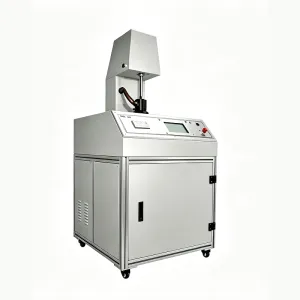
Testeur d'efficacité de filtration des particules
Leur classification: Filter Paper & Media Testing InstrumentsVues: 200Numéro:Temps de libération: 2026-07-17 08:40:41Le testeur d'efficacité de filtration des particules est un appareil de précision conçu pour tester l'efficacité de filtration des équipements de protection respiratoire tels que les masques et les tissus soufflés par fusion, adapté à l'évaluation des produits des séries KN et KP. L'équipement est conçu conformément à la norme GB 2626-2019 (Équipement de protection respiratoire — Respirateur à particules purifiant l'air non motorisé). Il utilise un générateur d'aérosol pour produire un aérosol de NaCl avec une concentration définie (≤200 mg/m³, granulométrie 0,075±0,02 μm). Un photomètre de haute précision mesure la concentration d'aérosols avant et après filtration, calculant l'efficacité de filtration des particules. La plage de débit est de 10 à 100 L/min avec une précision de 2 % et la pression est de 500 Pa. Le système se compose d'un générateur de particules, d'un dispositif de mesure du débit et d'un dispositif de mesure de la concentration, ainsi que d'un humidificateur et d'une chambre scellée pour simuler les conditions respiratoires réelles. Il s'agit de l'équipement standardisé pour les tests d'efficacité de filtration et le contrôle qualité dans la fabrication de masques et de tissus soufflés par fusion, les agences d'inspection et les instituts de recherche.
Actualités
Catégorie:
Aucun résultat de recherche!
Affaire
Catégorie:
Aucun résultat de recherche!
Vidéo
Catégorie:
Aucun résultat de recherche!
Téléchargement
Catégorie:
Aucun résultat de recherche!
Recrutement
Catégorie:
Aucun résultat de recherche!
Produits recommandés
Aucun résultat de recherche!



 Téléphone