
 English
 Español
 Pусский
 العربية


electronic thickness tester
An electronic thickness tester is a precision measuring instrument used to determine the thickness of materials quickly, accurately, and consistently. It is widely used in industries where dimensional control is essential, such as manufacturing, quality inspection, packaging, textiles, paper production, plastics, rubber, coatings, and metal processing. By providing reliable thickness data, this device helps ensure product quality, supports process control, and reduces material waste.The basic principle of an electronic thickness tester is to measure the distance between two surfaces of a sample by using an electronic sensor system. Compared with traditional mechanical thickness gauges, it offers higher accuracy, faster reading speed, and easier operation. Most models feature a digital display that shows measurement results clearly, allowing users to read values without manual interpretation. This reduces human error and improves consistency in inspection work.An electronic thickness tester usually consists of a measuring head, a stable frame or stand, a digital indicator, and a pressure mechanism. The measuring head applies a controlled force to the sample, ensuring that the measurement is taken under standardized conditions. This is especially important for soft, flexible, or compressible materials, where excessive pressure could affect the result. Some advanced models also include data output functions, allowing measurements to be transferred to computers or quality management systems for record keeping and analysis.These testers are available in different designs to suit different materials and applications. For thin films, paper, and foils, high-sensitivity models are used to detect very small thickness variations. For heavier materials such as sheets, boards, or metal components, stronger and more robust versions are available. Depending on the application, the device may use contact or non-contact measurement methods. Contact types are common for solid materials, while non-contact types are preferred when surface damage must be avoided.One of the main advantages of an electronic thickness tester is its efficiency. It allows operators to perform repeated measurements in a short time, making it ideal for production lines and laboratory testing. The digital interface simplifies operation and often includes functions such as zero setting, unit conversion, data hold, and calibration. These features help improve usability and support accurate testing over long periods of use.Regular thickness testing is important because material thickness often affects strength, appearance, performance, and safety. In industries like coatings or plastics, even small changes in thickness can influence product durability and customer satisfaction. Therefore, this instrument plays a key role in maintaining consistent standards and meeting technical requirements.In summary, an electronic thickness tester is a practical and dependable tool for modern measurement tasks. It combines accuracy, convenience, and speed, making it valuable in both laboratory and industrial environments. Its digital technology and versatile design make it an essential instrument for anyone who needs precise thickness control.
Produit
Catégorie:
-
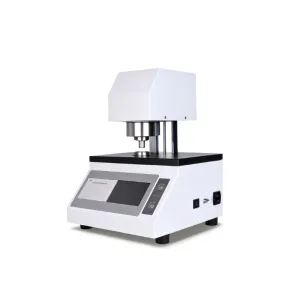
Testeur d'épaisseur de carte numérique
Leur classification: Paper Testing InstrumentsVues: 262Numéro:Temps de libération: 2026-07-10 09:50:59Le testeur numérique d'épaisseur de cartes est un instrument d'inspection mécatronique de nouvelle génération développé selon les normes nationales, intégrant des principes de conception mécanique modernes et des directives ergonomiques. Équipé d'un capteur de déplacement de haute précision et d'un système d'exploitation à écran tactile, il offre des fonctions complètes comprenant les tests, la conversion d'unités, l'affichage des données, le stockage en mémoire, l'impression et le traitement des données. La plage de mesure est de 0 à 18 mm avec une résolution de 0,01 mm, un écart d'indication de ±0,05 % et une répétabilité de mesure de 2,5 μm ou 0,5 %. La pression de mesure est de 20 ± 0,5 kPa, la surface de contact est de 1 000 ± 20 mm² et la vitesse de descente est ≤ 3 mm/s. Une imprimante thermique modulaire intégrée prend en charge les tests en une seule touche et le traitement automatique des données. L'instrument est conforme aux normes QB/T 1035, QB/T 451.3, QB/T 1055, ISO 534 et ISO 438, ce qui en fait un appareil de test d'épaisseur de carton idéal pour les industries de la fabrication du papier, de l'emballage, de la recherche et de la supervision de la qualité.
Actualités
Catégorie:
Aucun résultat de recherche!
Affaire
Catégorie:
Aucun résultat de recherche!
Vidéo
Catégorie:
Aucun résultat de recherche!
Téléchargement
Catégorie:
Aucun résultat de recherche!
Recrutement
Catégorie:
Aucun résultat de recherche!
Produits recommandés
Aucun résultat de recherche!



 Téléphone