
 English
 Español
 Pусский
 العربية


bending stiffness tester
A bending stiffness tester is a laboratory instrument used to measure the resistance of a material to bending or flexural deformation. It is widely applied in quality control, research and development, and product comparison for materials such as paper, cardboard, plastic films, textiles, nonwoven fabrics, leather, thin sheets, and other flexible or semi-rigid products. By evaluating how a sample responds when a controlled force is applied, the tester provides important data for understanding material rigidity, flexibility, and overall performance.The basic principle of a bending stiffness tester is to apply a force to a sample under standardized test conditions and record the force or moment required to produce a specific deflection or bending angle. Depending on the testing method, the sample may be clamped at one end and bent under its own weight, pressed by a moving probe, or placed on supports while a load is applied at the center. The instrument then calculates bending stiffness based on the relationship between applied force, displacement, and sample dimensions.Modern bending stiffness testers are usually equipped with a precision loading system, a sample fixture, a control unit, and a digital display or computer interface. The loading system ensures stable and accurate force application, while the fixture holds the sample in a consistent position to reduce operator error. Many models feature automatic calibration, programmable test speeds, and adjustable test parameters to meet different international standards. Some advanced versions also support data storage, curve analysis, and automatic report generation, making the testing process more efficient and reliable.One of the main advantages of a bending stiffness tester is its ability to provide objective and repeatable results. In manufacturing, even small differences in stiffness can affect packaging performance, product feel, printability, folding behavior, and durability. For example, in the paper industry, stiffness influences how well paper runs on high-speed machines and how a package maintains its shape. In textiles and nonwovens, bending stiffness affects drape, comfort, and hand feel. In plastics and films, it helps determine whether a material is suitable for folding, wrapping, or structural use.The tester is also valuable for comparing materials and optimizing formulations. Engineers and product developers can use stiffness data to modify thickness, composition, layering, or processing conditions in order to achieve the desired balance between flexibility and rigidity. Because test results are numerical and standardized, they can be used for incoming inspection, production monitoring, and product certification.In operation, a bending stiffness tester is generally simple to use. The operator prepares the sample according to the required size and conditioning conditions, places it in the test fixture, and starts the test. The instrument performs the measurement automatically and displays the result in units such as mN·m, N·mm, or other standardized values. To ensure accuracy, regular calibration and proper sample preparation are essential.In summary, a bending stiffness tester is an important tool for measuring the flexural properties of materials. It helps manufacturers, laboratories, and researchers evaluate product quality, improve design, and maintain consistent performance across production batches.
Produit
Catégorie:
-
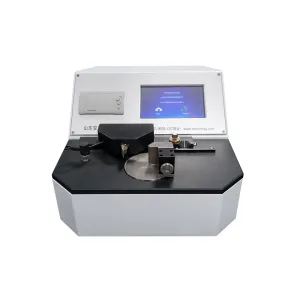
Testeur numérique de rigidité à la flexion
Leur classification: Paper Testing InstrumentsVues: 358Numéro:Temps de libération: 2026-07-10 08:50:01Le testeur numérique de rigidité à la flexion est un instrument professionnel permettant de mesurer la rigidité à la flexion du papier et du carton. Il convient à la détermination statique de la rigidité à la flexion de divers papiers, cartons et matériaux d'emballage. En tant que pionnier dans l'adoption d'une interface homme-machine à affichage de courbe LCD, ce testeur multifonctionnel permet de régler librement l'angle de courbure entre 1° et 90°, couvrant les tests standard de 7,5° et 15° ainsi que le test de rigidité au pli à 90°. La longueur de pliage est sélectionnable de 5 à 50 mm par pas fixes (version manuelle) ou réglable en continu de 5 à 60 mm (version automatique), et le temps de test peut être réglé de 3 à 35 secondes. L'instrument dispose d'une mise à zéro automatique, d'un affichage de la courbe force-temps-angle en temps réel, de statistiques de mesure automatiques et d'une impression. Après test, il revient à la position initiale à grande vitesse avec une vitesse de retour réglable de 0,55 à 20°/s. Tous les paramètres de performance sont conformes aux normes GB/T 23144 et GB 22364-2018, ce qui en fait un instrument de configuration standard pour les tests de rigidité à la flexion dans les usines de papier, les industries de l'emballage, les instituts de recherche et les agences d'inspection qualité.
Actualités
Catégorie:
Aucun résultat de recherche!
Affaire
Catégorie:
Aucun résultat de recherche!
Vidéo
Catégorie:
Aucun résultat de recherche!
Téléchargement
Catégorie:
Aucun résultat de recherche!
Recrutement
Catégorie:
Aucun résultat de recherche!
Produits recommandés
Aucun résultat de recherche!



 Téléphone