Présentation du produit
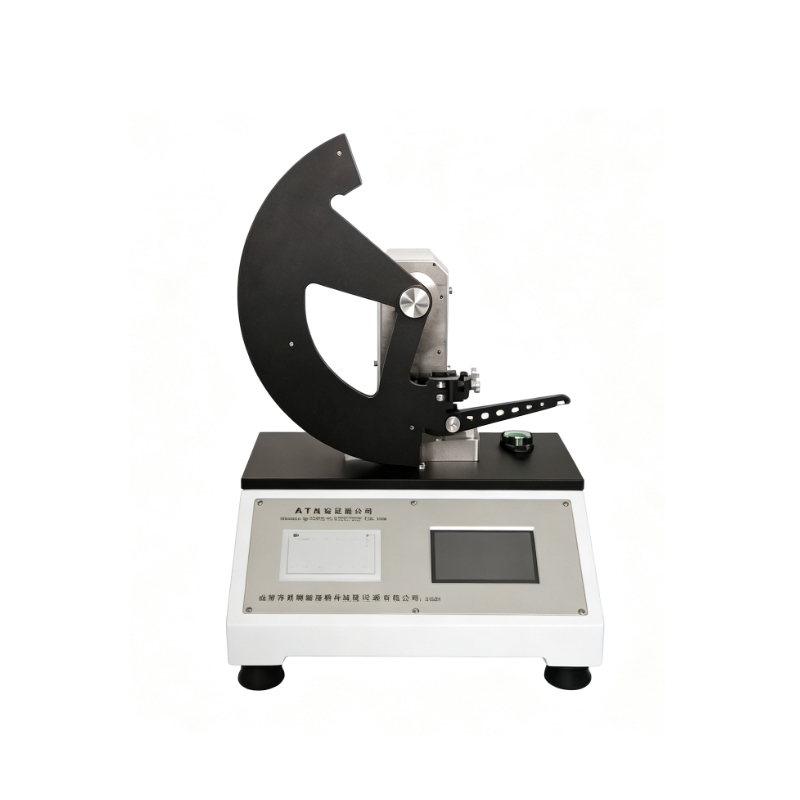
Le paper tearing tester fonctionne selon le principe de la méthode Elmendorf, mesurant la force nécessaire pour déchirer un échantillon de papier ou de carton afin d'évaluer sa résistance à la déchirure. Un échantillon de taille standard avec une fente initiale prédécoupée est serré entre des supports de type pendule. Lorsque le pendule est relâché, il arrache l'échantillon de la fente initiale lors de son oscillation. L'instrument utilise un encodeur d'arbre photoélectrique de haute précision pour mesurer l'énergie consommée pendant le processus de déchirure et la convertit en une valeur de force de déchirure affichée sur l'écran LCD. Le système de contrôle informatique automatise les tests, le traitement des données et l’affichage des résultats, avec une interface conviviale pour une utilisation simple.
Principales fonctionnalités
Large plage de mesure de haute précision Plage de mesure de 10 à 8 000 mN, extensible en option à 16 000 mN, répondant aux besoins de test du papier fin au carton plus résistant.
Méthode Elmendorf standard Entièrement conforme aux normes ISO 1974 et GB 455.1, fournissant des résultats de tests internationalement reconnus adaptés au contrôle qualité, à la R&D et à l'enseignement.
Encodeur photoélectrique de haute précision Utilise un encodeur d'arbre photoélectrique de haute précision pour une mesure précise et reproductible de l'énergie de déchirure.
Interface d'affichage LCD Interface à l'écran intuitive pour un réglage simple des paramètres et une visualisation des résultats.
Conception mécatronique intégrée Combine une structure mécanique de précision avec un contrôle par micro-ordinateur, offrant une conception compacte, des performances stables et une maintenance facile.
Coupe initiale de l'échantillon standard Longueur de coupe initiale 20 ± 0,5 mm et distance de serrage 2,8 ± 0,3 mm, strictement conforme aux spécifications standard.
Mécanisme de libération pendulaire fiable L'angle de déchirement initial de 27,5 ± 0,5 ° et la longueur du bras de déchirement de 104 ± 1 mm garantissent des conditions de test cohérentes et standardisées.
Poids d'étalonnage inclus Fourni avec deux poids d'étalonnage standard pour une vérification et un étalonnage de routine pratiques.
Principales spécifications techniques
Paramètre | Spécification |
Plage de mesure | 10 – 8 000 mN (en option 8 000-16 000 mN) |
Angle de déchirure initial | 27,5 ± 0,5° |
Longueur de coupe initiale | 20 ± 0,5 mm |
Distance de serrage | 2,8 ± 0,3 mm |
Longueur du bras déchirant | 104 ± 1 mm |
Afficher | Écran LCD |
Dimensions hors tout (L×L×H) | 400 × 310 × 580 mm |
Poids | Env. 30 kg |
Accessoires inclus | Poids d'étalonnage standard (2 pièces) |
Normes applicables | OIN 1974, GB 455.1 |
FAQ
1. Quels types de papier et de carton conviennent aux tests de déchirure ?
Il convient à différents types de papier et de carton de faible résistance. Pour les panneaux épais présentant une résistance élevée à la déchirure, la plage de mesure étendue jusqu'à 16 000 mN peut être sélectionnée. Veuillez nous consulter pour confirmer l’applicabilité.
2. Quelle préparation des échantillons est requise avant le test ?
Les spécimens doivent être découpés aux dimensions spécifiées et conditionnés à une température et une humidité standard. Une coupe initiale standard doit être effectuée sur chaque éprouvette. Reportez-vous à la norme ISO 1974 ou GB 455.1 pour connaître les exigences détaillées en matière de taille et les méthodes de préparation.
3. Comment puis-je garantir l’exactitude des mesures ?
L'instrument est calibré en usine. Une vérification de routine peut être effectuée à l'aide des poids d'étalonnage standard inclus. Assurez-vous que les échantillons sont serrés à plat, que les coupes initiales sont correctement effectuées et que l'environnement de test répond aux exigences standard.
4. L'instrument peut-il mesurer à la fois la déchirure dans le sens machine et dans le sens transversal ?
Oui. La déchirure du papier est généralement testée dans le sens machine (MD) et dans le sens travers (CD). La méthode de test est identique ; seule la direction de coupe de l'éprouvette diffère. La comparaison de la résistance à la déchirure du MD et du CD permet d'évaluer l'anisotropie du papier.
5. Que faire si l'écran LCD semble anormal ou peu clair ?
Vérifiez d’abord la connexion électrique. Si l'affichage reste anormal, cela peut être dû à un câble desserré ou à un problème de rétroéclairage. Contactez notre équipe après-vente pour une inspection ; ne démontez pas le module d'affichage vous-même.
6. Le mécanisme du pendule nécessite-t-il une lubrification régulière ?
Les roulements du pendule sont lubrifiés en usine et ne nécessitent généralement pas de réhuilage fréquent. Gardez l'équipement propre et essuyez périodiquement le corps avec un chiffon doux pour empêcher la poussière de pénétrer dans les composants du roulement. Si le mouvement du pendule devient raide, contactez le service après-vente.
Service après-vente
Créé en 2007 et avec près de deux décennies d'expérience, Shandong Annimet Instrument Co., Ltd. est un fabricant professionnel intégrant la R&D, la production et la vente d'équipements de tests en laboratoire et de préparation d'échantillons. La qualité est notre fondement. Nous sommes votre pont entre le concept et la réalité. Nous fournissons bien plus que de simples instruments : nous apportons la confiance. Ce testeur de déchirure du papier est livré avec une garantie de 12 mois et une assistance technique à vie. Notre équipe de professionnels offre une réponse de service 24h/24 et 7j/7, des conseils d'installation gratuits, une formation au fonctionnement et une consultation sur les méthodes de test. Pour toute demande de renseignements, veuillez contacter notre service client ; nous nous engageons à fournir un support complet avant-vente, en vente et après-vente. Ligne d'assistance : 400-9933-057, e-mail : anmt_test@126.com.
La résistance à la déchirure est une propriété mécanique essentielle du papier et du carton, reflétant la capacité du matériau à résister aux forces de déchirure. Le papier est fréquemment soumis à des déchirures lors de l'impression, de l'emballage, de la transformation et de l'utilisation finale, comme l'alimentation en bande dans les presses à imprimer, le scellage des sacs et l'ouverture de l'emballage. Une résistance à la déchirure insuffisante peut entraîner une déchirure facile et une défaillance du produit. La méthode Elmendorf est la norme internationalement reconnue pour les tests de déchirure, mesurant l'énergie consommée par un pendule pour déchirer un échantillon prédécoupé afin de caractériser la résistance à la déchirure du matériau. Les normes ISO 1974 et GB 455.1 définissent des spécifications uniformes pour les principes de test, les dimensions des échantillons, la longueur de coupe initiale et les conditions de test afin de garantir la comparabilité des données entre laboratoires. Les testeurs de déchirure numériques modernes utilisent des technologies de codage photoélectrique et de contrôle par micro-ordinateur, automatisant le processus de test et améliorant considérablement l'efficacité et la précision. Ces instruments sont largement utilisés dans le contrôle qualité dans les usines de papier, l'évaluation des performances des matériaux d'emballage, la recherche sur les matériaux dans les instituts scientifiques et l'inspection des produits dans les agences qualité.
 RELATED

Shandong Annimet Instruments Co., Ltd., established in 2007, is a professional manufacturer integrating R&D, production, and sales of laboratory testing instruments and sample preparation equipment. With nearly two decades of industry experience, we are committed to delivering reliable quality testing solutions to clients worldwide.
Contact: +86 400-9933-057
Company Address: Factory Building 105, No. 155, Xinmao Qilu Science and Technology City, No. 299 Zidong Avenue, Tianqiao District, Jinan City, Shandong Province
E-mail: anmt_test@126.com
Fax: +86 0531-88092218
Copyright © 2026 Shandong Annimet Instruments Co., Ltd. All rights reserved
Plan du siteCe site Web utilise des cookies pour vous garantir la meilleure expérience sur notre site Web.

 English
 Español
 Pусский
 العربية



 Téléphone